

Example 1: convert ⅞ base ten to base two.
Solution:
First step is to split the given fraction into smaller fractions.
⅞ = (4 + 2 + 1)/8
= 4/8 + 2/8 + 1/8
Reduce each fraction to its lowest terms.
= ½ + ¼ + ⅛
Note that when you add all those fractions, you will still arrive at the original fraction given.
Let us proceed
½ + ¼ + ⅛ = 2–¹ + 4–¹ + 8–¹
Recall that any number raised to power minus 1 is one over that particular number, that is x–¹ = ¹/x.
Second step is to make sure they have a common base
½ + ¼ + ⅛ = 2–¹ + 4–¹ + 8–¹
= 2–¹ + 2²(–¹) + 2³(–1)
Opening of the parentheses
= 2–¹ + 2–² + 2–³
Third step is to provide a multiplication partners to each and every digits of the above fractions that will keep them unchanged when they are being multiplied.
= 2–¹ + 2–² + 2–³
= 1 x 2–¹ + 1 x 2–² + 1 x 2–³
⅞ base ten = 0.111 base two.
Example 2: Convert 9⅜ base ten to base two.
First is to convert 9 base ten to its base two.

9 base ten = 1001 base two.
⅜ = (2 + 1)/8 = 2/8 + ⅛
= ¼ + ⅛ = 4–¹ + 8–¹
Making the base uniform
= 2²(–¹) + 2³(–¹)
= 2–² + 2–³
= 1 x 2–² + 1 x 2–³
Check very well you will see that something is missing which we have to provide in that number.
In 1 x 2–² + 1 x 2–³, we have (-2) and (-3) without having (-1). So we have to fix it in the exact place it is supposed to be by multiplying it by zero.
= 0 x 2–¹ + 1 x 2–² + 1 x 2–³
= .011 base two
9⅜ ten = 9 + ⅜
= (1001 + .011) base two
= 1001.011 base two.
QUESTIONS AND SOLUTIONS:
Q1. Convert (17.25) base ten to base two.
Solution:
First we convert 17 base ten to base two.
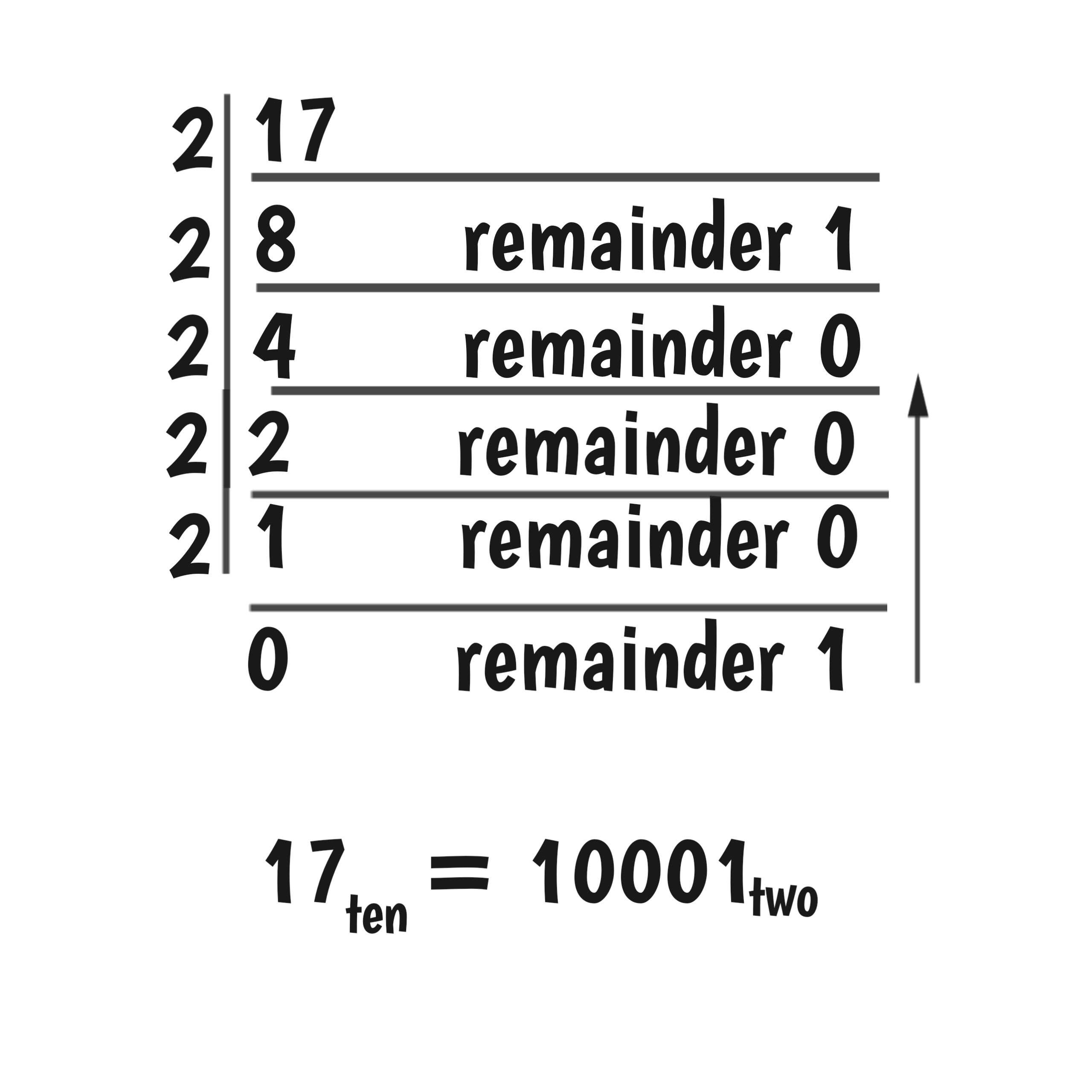
17 base ten = 10001 base two.
Now, let us convert (.25) to base two as well.
.25 base ten
= 25/100 = ¼
0.25 = ¼ = 4–¹ = 2–² = 1 x 2–²
We can see that something is missing which is (-1). We have to fix and multiply it by zero.
0.25 base ten = 0 x 2–¹ + 1 x 2–² = 0 1
Therefore 17.75 base ten = 10001.01 base two.
Q2. Convert (9.75) base ten to base two.
Solution:
First we convert the integral part to base two.

9 base ten = 1001 base two.
Convert the decimal part to base five as well.
0.75 base ten = 75/100
= (3/4) = (2/4) + (1/4)
= ½ + ¼
= 2–¹ + 4–¹ = 2–¹ + 2–²
= 1 x 2–¹ + 1 x 2–²
= 1 1
So, (9.75) base ten = 1001.11 base two.
Q3. Convert 1011.011 base two to fraction.
Solution:
First we convert the integral part to base ten.
1011 base two
= 1 x 2³ + 0 x 2² + 1 x 2¹ + 1 x 2°
= 8 + 0 + 2 + 1
= 11 base ten.
Now, convert the decimal part to base ten too.
.011 base two
= 0 x 2–¹ + 1 x 2–² + 1 x 2–³
= 0 + 2–² + 2–³
= (1/2²) + (1/2³)
= 1/4 + 1/8
= ⅜ base ten
So, 1011.011 base two
= 11⅜ base ten.
Q4. Convert (3⅞) base ten to bicimal.
Solution:
First we convert the integral part to base two.
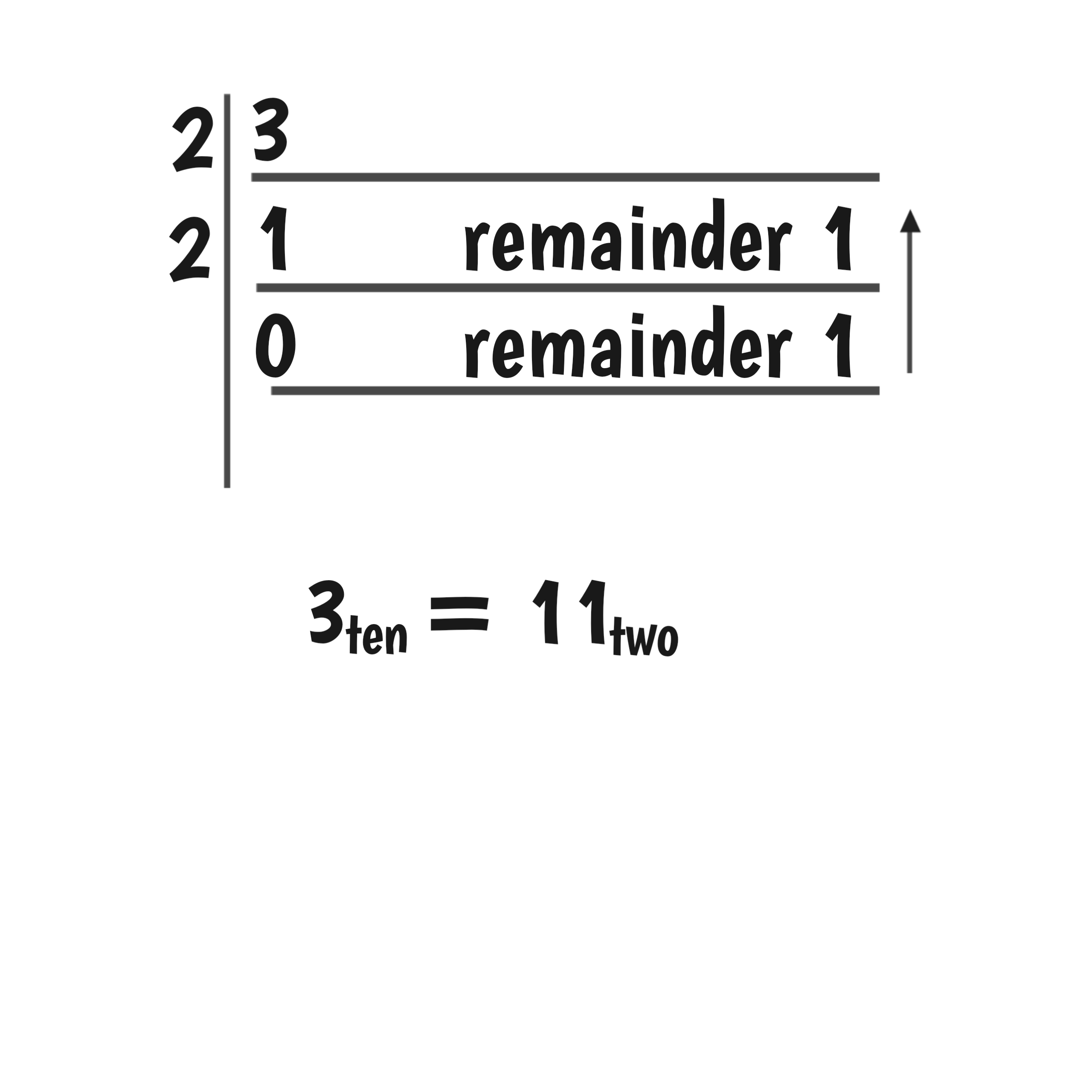
3 base ten = 11 base two
Convert the ⅞ base ten to base two
⅞ = (4 + 2 + 1)/8
= 4/8 + 2/8 + 1/8
= 1/2 + 1/4 + 1/8
= 2–¹ + 2–² + 2–³
= 1 x 2–¹ + 1 x 2–² + 1 x 2–³
= .111 base two
Thus, (3⅞) base ten = 11.111 base ten.
Q5. Convert 57/64 base ten to bicimal.
Solution:
57/64 = (32 + 16 + 8 + 1)/64
= 32/64 + 16/64 + 8/64 + 1/64
= 1/2 + 1/4 + 1/8 + 1/64
= 2–¹ + 4–¹ + 8–¹ + 64–¹
= 2–¹ + 2–² + 2–³ + 2^–6
As you can see that (-4) and (-5) are missing, we have to provide them by multiplying them by zero.
= 1 x 2–¹ + 1 x 2–² + 1 x 2–³ + 0 x 2–⁴ + 0 x 2^–5 + 1 x 2^–6
= 0.111001 base two
Q6. Convert 0.123 base four to bicimal.
_Note before that decimal is to base ten as bicimal is to base two_
Solution:
First convert 0.123 base four to base ten.
0.123 base four
= 1 x 4–¹ + 2 x 4–² + 3 x 4–³
= 1 x ¼ + 2 x ¼² + 3 x ¼³
= ¼ + ⅛ + 3/64
= 27/64 base ten.
Now, convert the base ten to bicimal
27/64 base ten
= ¼ + ⅛ + 3/64
= ¼ + ⅛ + 2/64 + 1/64
= ¼ + ⅛ + 1/32 + 1/64
= 4–¹ + 8–¹ + 32–¹ + 64–¹
= 2–² + 2–³ + 2^–5 + 2^–6
Do you notice that (-1) and (-4) are missing?, We have to provide them the way we use to.
= 0 x 2–¹ + 1 x 2–² + 1 x 2–³ + 0 x 2–⁴ + 1 x 2^–5 + 1 x 2^–6
= 0.011011 base two
Q7. Convert 34 base five to binary.
Solution:
We have to convert to base ten first.
34 base five
= 3 x 5¹ + 4 x 5°
= 3 x 5 + 4 x 1
= 15 + 4 = 19 base ten
Now, convert to the required base.

34 base five = 10011 base two.