

ADDITION AND SUBTRACTION IN NUMBER BASES.
Most students have been finding it so difficult to add or subtract in number bases. The method used on tackling the problems is not different from what we have done here.
Example 1:
If you are given 264, 86, 475 all in base nine to be added.
Do not hesitate to convert those numbers first to base ten.
For 264 base nine
= 2 x 9² + 6 x 9¹ + 4 x 9° = 162 + 54 + 4
= 220 base ten
For 86 base nine
= 8 x 9¹ + 6 x 9° = 72 + 6
= 78 base ten
For 475 base nine
= 4 x 9² + 7 x 9¹ + 5 x 9° = 324 + 63 + 5
= 392 base ten
Step two: Add up all those numbers in base ten.
220 + 78 + 392 = 690 base ten.
Final step is to convert it back to base nine.
Learn how to convert from base ten to any required base here.
 Therefore, 264 + 86 + 475 base nine
 Example 2.
Subtract 265 from 317 in base eight.
Solution:
First convert to base ten.
For 265 base eight
= 2 x 8² + 6 x 8¹ + 5 x 8° = 128 + 48 + 5
= 181 base ten
For 317 base eight
= 3 x 8² + 1 x 8¹ + 7 x ° = 192 x 8 x 7
= 207 base ten
Step two: Now subtract
207 - 181 = 26 base ten.
Final step is to convert it back to base eight.

Thus, 317 - 265 in base eight = 32 base eight.
Example 3.
If 123 + 1302 + xxxx in base four is 10122 base four, find the missing figure.
Solution:
First convert the known figures to base ten.
For 123 base four
= 1 x 4² + 2 x 4¹ + 3 x 4° = 16 + 8 + 3
= 27 base ten
For 1302 base four
= 1 x 4³ + 3 x 4² + 0 x 4¹ + 2 x 4°
= 64 + 48 + 0 + 2
= 114 base ten
For 10122 base four
= 1 x 4⁴ + 0 x 4³ + 1 x 4² + 2 x 4¹ + 2 x 4°
= 256 + 0 + 16 + 8 + 2
= 282 base ten
Step 2: Subtract (27 + 114) base ten from 282 base ten
= 282 - 141 = 141 base ten
Step 3: Convert the 141 base ten back to the required base .

Therefore, xxxx = 2031.
MULTIPLICATION AND DIVISION OF NUMBER BASES
This is not different from the one we have done when adding or subtracting number bases. As far as you know what multiplication, division, addition and subtraction are all about. All you have to do first is to convert to base ten, then return the answer gotten to the required base.
Example 1:
Evaluate (321 base six) X 25 base six
Solution:
Step 1: Convert to base ten first.
For 321 base six
= 3 x 6² + 2 x 6¹ + 1 x 6°
= 108 + 12 + 1
= 121 base ten
For 25 base six
= 2 x 6¹ + 5 x 6°
= 12 + 5
= 17 base ten
Step 2: Multiply 121 by 17
= 121 x 17
= 2057 base ten
Step 3: Convert back to base six
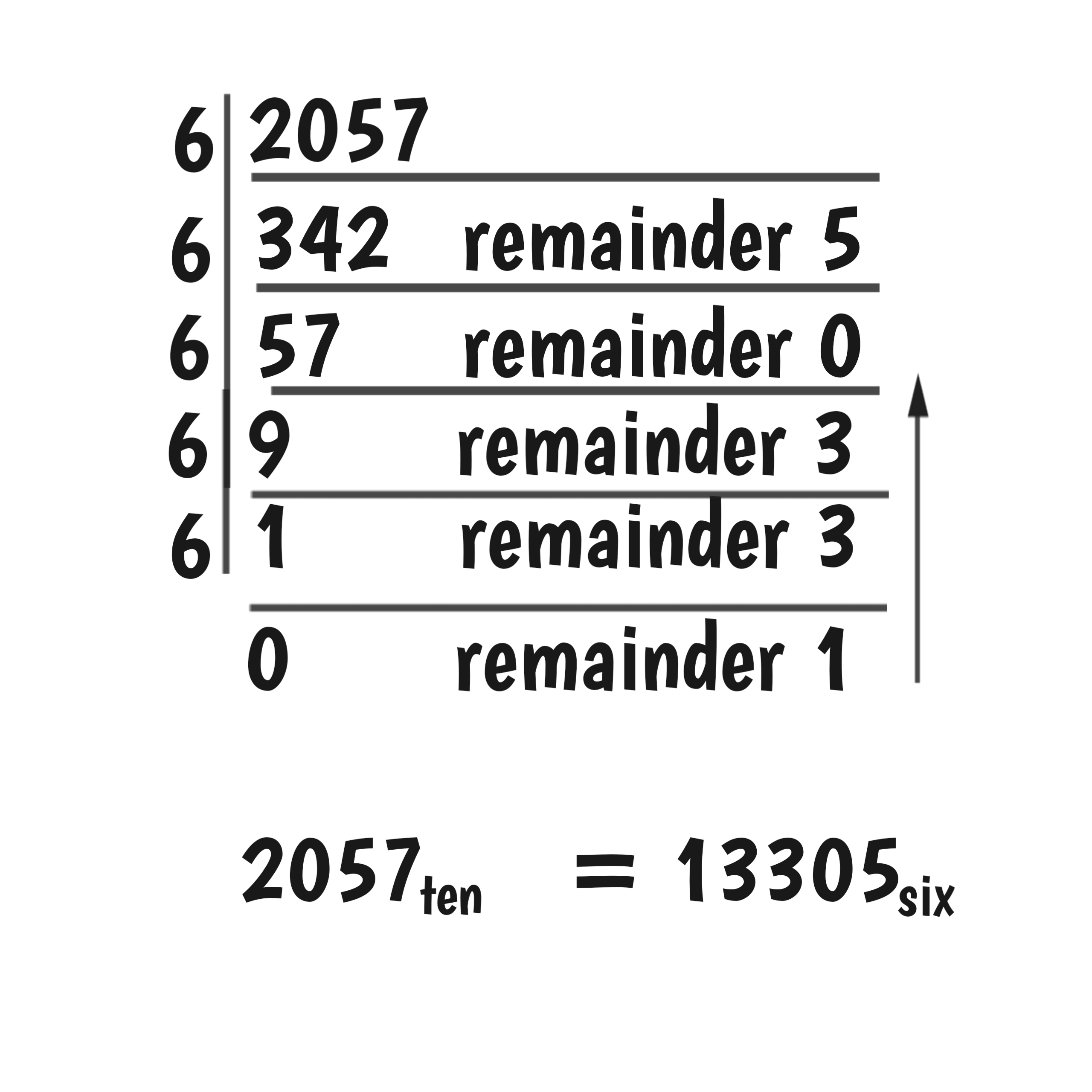
321 base X 25 base six = 13305 base six.
Example 2:
Find the product of 1011 base two and 1101 base two.
Solution:
Step 1: Convert to base ten
For 1011 base two
= 1 x 2³ + 0 x 2² + 1 x 2¹ + 1 x 2°
= 8 + 0 + 2 + 1
= 11 base ten
For 1101 base two
= 1 x 2³ + 1 x 2² + 0 x 2¹ + 1 x 2°
= 8 + 4 + 0 + 1
= 13 base ten
Step 2: Multiply the two.
11 x 13 = 143 base ten
Step 3: Convert it back to base two.

1011 base two X 1101 base two = 10001111 base two
Example 3:
If 231 base four X 10101 base two = "M" base six, Find M.
Solution:
Do you notice that they are of different bases?. Do not panic because you can still solve it😊😊
Step1: Convert the two numbers to base ten
For 231 base four
= 2 x 4² + 3 x 4¹ + 1 x 4°
= 32 + 12 + 1
= 45 base ten
For 10101 base two
= 1 x 2⁴ + 0 x 2³ + 1 x 2² + 0 x 2¹ + 1 x 2°
= 16 + 0 + 4 + 0 + 1
= 21 base ten
Step 2: Multiply the two.
45 x 21 = 945 base ten
Step 3: Convert to the required base.

231 base four X 10101 base two = 4213 base six
Therefore, M = 4213
Example 4:
Evaluate 2115 base seven ÷ 12 base seven
Solution:
Step 1: Convert to base ten
For 2115 base seven
= 2 x 7³ + 1 x 7² + 1 x 7¹ + 5 x 7°
= 686 + 49 + 7 + 5
= 747 base ten
For 12 base seven
= 1 x 7¹ + 2 x 7°
= 7 + 2 = 9 base ten
Step 2: Now divide.
747/9 = 83 base ten
Step 3: Convert back to base seven.

83 base ten = 146 base seven.
So, (2115 ÷ 12) base ten = 146 base seven.
Example 5:
Divide 1423 by 24 in base five.
Solution:
Step 1: Convert to base ten
For 1423 base five
= 1 x 5³ + 4 x 5² + 2 x 5¹ + 3 x 5°
= 125 + 100 + 10 + 3
= 238 base ten
For 24 base five
= 2 x 5¹ + 4 x 5°
= 10 + 4 = 14 base ten
Step 2: Divide
238/14 = 17 base ten
Step 3: Convert back to base five

Therefore:
1423 base five ÷ 24 base five = 32 base five
OTHER CASES OF NUMBER BASES.
Number bases sometimes have unknown that must be made known.
Example 1:
Calculate "y" if 134 base "y" = 54 base eight
Step 1: Convert both sides to base ten
For 134 base "y"
= 1 x y² + 3 x y¹ + 4 x y°
= (y² + 3y + 4) base ten
For 54 base eight
= 5 x 8¹ + 4 x 8°
= 40 + 4 = 44 base ten
Step 2: Equate the two terms.
(y² + 3y + 4) = 44
y² + 3y + 4 = 44
y² + 3y + 4 -44 = 0
y² + 3y - 40 = 0
Solving the quadratic equation
y² + 8y - 5y - 40 = 0
y(y + 8) - 5(y + 8) = 0
(y - 5)(y + 8) = 0
Either (y - 5) = 0
or (y + 8) = 0
When y - 5 = 0
y = 5
And when y + 8 = 0
y = - 8
Number base cannot take a negative value,
so y = 5.
Example 2:
If 251 base "b" = 100 base two, find the value of "b".
Solution:
Similar thing we did in example 1 above will be done here too.
Step 1: Convert to base ten.
For 251 base "b"
= 2 x b² + 5 x b¹ + 1 x b°
= (2b² + 5b + 1) base ten
For 100 base two
= 1 x 2² + 0 x 2¹ + 0 x 2°
= 4 + 0 + 0 = 4 base ten
Equating both of them
(2b² + 5b + 1) = 4
2b² + 5b + 1 = 4
2b² + 5b + 1 - 4 = 0
2b² + 5b - 3 = 0
2b² + 6b - b - 3 = 0
2b(b + 3) - 1(b + 3) = 0
(2b - 1)(b + 3) = 0
So, either 2b - 1 = 0 or
b + 3 = 0
If 2b - 1 = 0
b = 1/2
And if b + 3 = 0
b = -3
Base cannot have negative sign, hence b = 1/2
QUESTIONS AND SOLUTIONS
Q1. Evaluate 3112 base five X 34 base five.
Solution:
Step 1: Convert to base ten
For 3112 base five
= 3 x 5³ + 1 x 5² + 1 x 5¹ + 2 x 5°
= 375 + 25 + 5 + 2 = 407 base ten
For 34 base five
= 3 x 5¹ + 4 x 5°
= 15 + 4 = 19 base ten
Step 2: Multiply both
407 x 19 = 7733 base ten
Step 3: Convert back to base five

(3112 x 34) base five = 221413 base five
Q2. Divide 2173 by 16 in base nine
Solution:
Convert to base ten.
For 2173 base nine
= 2 x 9³ + 1 x 9² + 7 x 9¹ + 3 x 9°
= 1458 + 81 + 63 + 3
= 1605 base ten
For 16 base nine
= 1 x 9¹ + 6 x 9°
= 9 + 6 = 15 base ten
Divide the numbers
1605/15 = 107 base ten
Return to base nine

2173 base nine ÷ 16 base nine = 128 base nine.
Q3. 111 x 101 in base two
Solution:
Convert to base ten
For 111 base two
= 1 x 2² + 1 x 2¹ + 1 x 2°
= 4 + 2 + 1 = 7 base ten
For 101 base two
= 1 x 2² + 0 x 2¹ + 1 x 2°
= 4 + 0 + 1 = 5 base ten
Multiply the both
7 x 5 = 35 base ten
Return the number base ten to base two

111 x 101 in base two = 100011 base two
Q4. 3132 base eight + 6 base eight
Solution:
Convert to base ten
For 3132 base eight
= 3 x 8³ + 1 x 8² + 3 x 8¹ + 2 x 8°
= 1536 + 64 + 24 + 2
= 1626 base ten
For 6 base eight
= 6 x 8° = 6 base ten
Add the two numbers
1626 + 6 = 1632 base ten
Return it to base eight

3140 base eight.
Q5. If 25 x 14 = 374, find the number base used.
Solution:
Let the number base used be "y"
(25 base y) X (14 base y) = 374 base y
Convert all to base ten
For 25 base y
= 2 x y¹ + 5 x y°
= (2y + 5) base ten
For 14 base y
= 1 x y¹ + 4 x y°
= (y + 4) base ten
For 374 base y
= 3 x y² + 7 x y¹ + 4 x y°
= (3y² + 7y + 4) base ten
If (25 base y) X (14 base y) = 374 base y
Then,
(2y + 5)(y + 4) = 3y² + 7y + 4
Expand the equation
2y² + 8y + 5y + 20 = 3y² + 7y + 4
Collection of like terms
2y² - 3y² + 13y - 7y + 20 - 4 = 0
-y² + 6y + 16 = 0
y² - 6y - 16 = 0
y² - 8y + 2y - 16 = 0
y(y - 8) + 2(y - 8) = 0
(y + 2)(y - 8) = 0
y = - 2 or 8
Therefore y = 8
Q6. Given that 132 base five = P base six, find P.
Solution:
Convert to base ten
For 132 base five
= 1 x 5² + 3 x 5¹ + 2 x 5°
= 25 + 15 + 2
= 42 base ten
For P base six
= P x 6° = P base ten
Equating both sides
P = 42 base ten
Convert back to base six

P = 110 base six
Q7. If 244 base n = 1022 base four, find n.
Solution:
Convert to base ten
For 244 base n
= 2 x n² + 4 x n¹ + 4 x n °
= (2n² + 4n + 4) base ten
For 1022 base four
= 1 x 4³ + 0 x 4² + 2 x 4² + 2 x 4°
= 64 + 0 + 8 + 2
= 74 base ten
Equating both of them
(2n² + 4n + 4) = 74
2n² + 4n - 70 = 0
n² + 2n - 35 = 0
(n - 5)(n + 7) = 0
n = 5 or - 7
Therefore n = 5
because we do not have negative base
Q8. A number is written as 52 base x. Four times the number is written as 301 base x. What is x?
Solution:
A number = 52 base x
Four times the number = 4 X 52 base x = 301 base x
Convert to base ten
For 4
= 4 X x° = 4 base ten
For 52 base x
= 5 X x¹ + 2 X x°
= (5x + 2) base ten
For 301 base x
= 3 X x² + 0 X x¹ + 1 X x °
= 3x² + 0 + 1
= (3x² + 1) base ten
4(5x + 2) = 3x² + 1
20x + 8 = 3x² + 1
3x² - 20x - 7 = 0
Let us use quadratic formula to find the value of "x"

Q9. Arrange the following in ascending order.
Q10. If 321 base n = 232 base seven. Find the value of n.

Q11. Simplify the following binary numbers.


Q12. Simplify 342 base five + 134 base five + 223 base five and leave your answer in base

Q13. Multiply (12012) base three by (201) base three.

